Cells with high energy density can operate for longer durations and deliver greater ranges before requiring recharge, making them well suited for applications such as electric vehicles and portable electronics. Achieving high energy density requires electrode structures that permit extensive ion intercalation and de-intercalation, while also maintaining a compact design to maximize the amount of active material per unit volume. Electrode materials capable of storing many lithium ions are typically dense and tightly packed, which increases storage capacity. However, this compactness also leads to longer and more tortuous pathways for ion and electron transport, raising internal resistance and slowing charge–discharge kinetics.
In contrast, cells with high power density are designed to deliver rapid bursts of energy, which is critical for applications like power tools or regenerative braking in vehicles. High power density is typically achieved by using materials with high surface area and short transport pathways for ions and electrons. Thinner electrodes facilitate faster ion and electron movement due to reduced travel distances, enhancing charge and discharge rates. The trade-off, however, is that thinner electrodes hold less active material, reducing overall energy capacity. Conversely, thicker electrodes can store more lithium ions and increase energy density, but the longer diffusion pathways impede transport and diminish power performance.
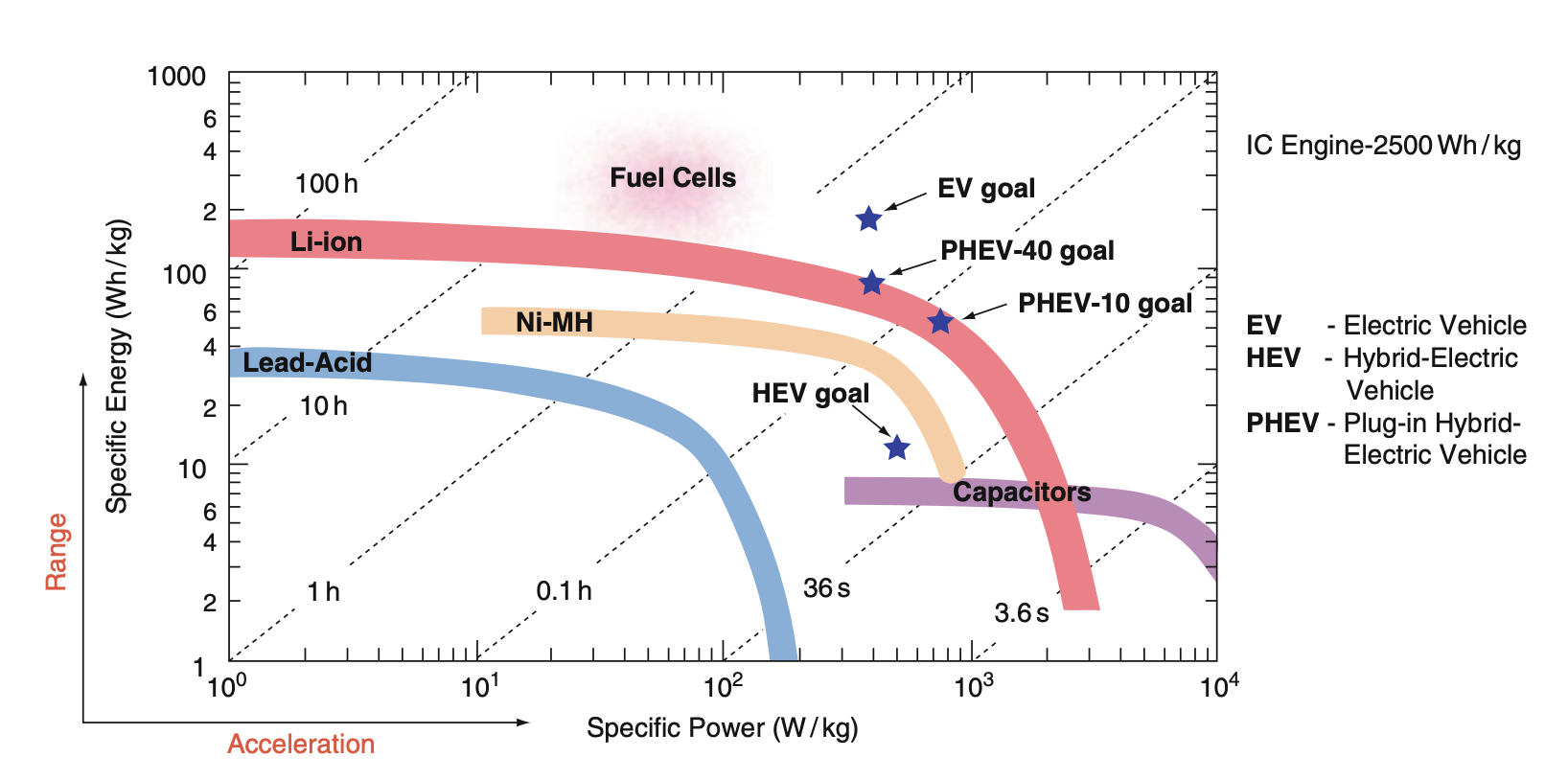
This is a Ragone plot, a diagram that compares the energy density (specific energy) and power density (specific power) of various energy storage devices. Such plots are instrumental in visually conveying the balance between a device’s energy storage capacity and its ability to rapidly deliver that energy. As illustrated in this diagram, lithium-ion batteries are located approximately in between fuel cells (high specific energy but lower specific power suitable for extended range applications where instantaneous energy delivery is not paramount) and capacitors (lower specific energy but can deliver very high specific power ideal for applications requiring quick bursts of energy). This positioning underscores lithium-ion batteries’ versatility, providing a balanced solution that offers a commendable range while retaining the capability to supply energy at a rate sufficient for most mainstream applications, including portable electronics and electric vehicles.
 Chemical Sustainability