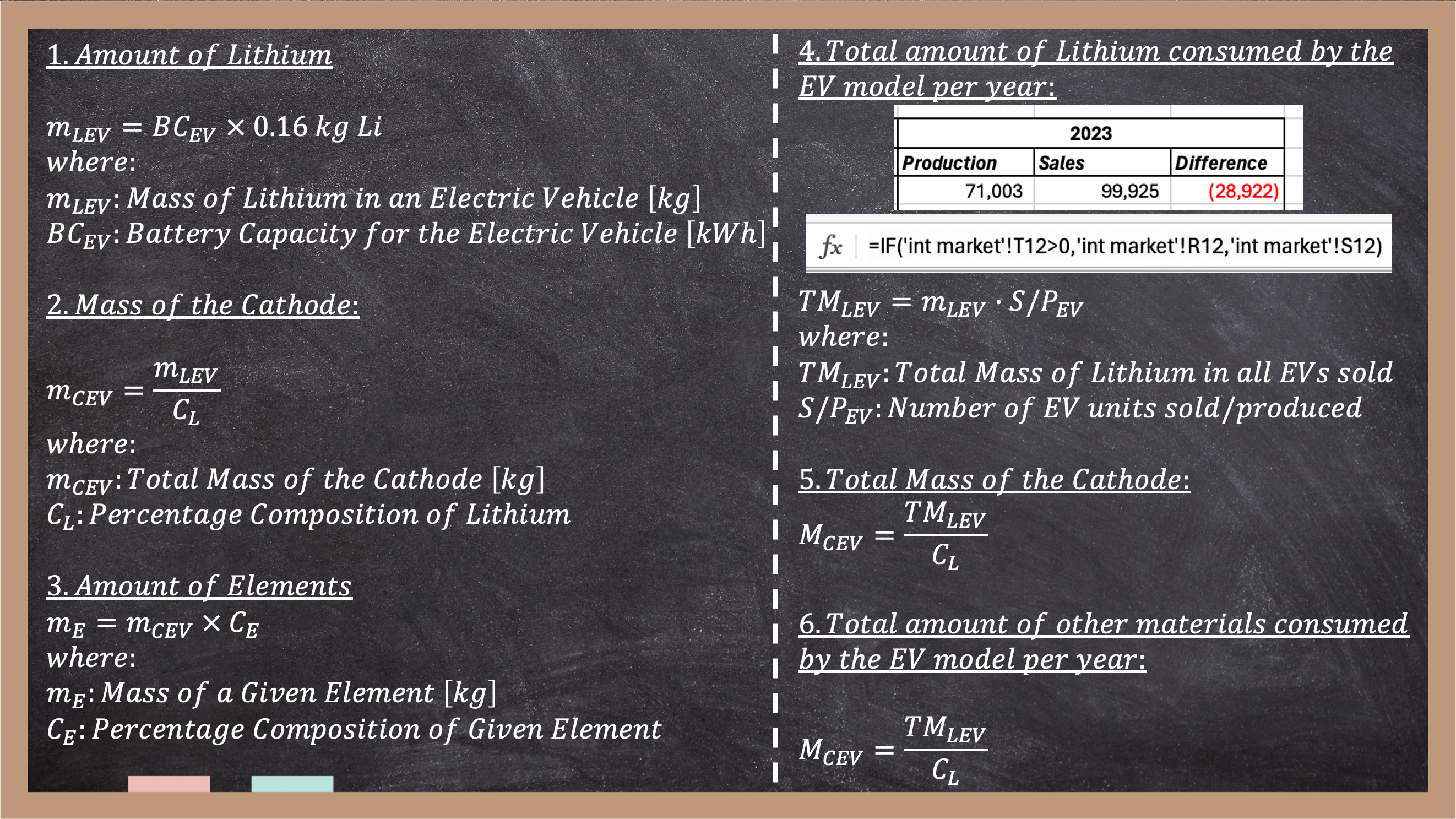
The first step to answer this question involves finding the equivalence between lithium and battery capacity, i.e., how much lithium is required to deliver given unit of stored energy, typically expressed in kilowatt-hours (kWh) of battery capacity – or in other words, how much lithium is required to deliver the usable energy of an EV battery pack, and thus how this translates into material demand per vehicle.

From the previous equivalence, the amount of lithium (as in, the mass of lithium) in the battery can be determined (1. Amount of Lithium).
Because we know the fraction of lithium in the cathode, we can find the total mass of the cathode (2. Mass of the Cathode) using the mass of lithium we just calculated.
Then, since we now know how heavy the cathode is and the proportions of material in a cathode (the NMC, NMA, etc proportions, remember?), we can now find out how much of each element is in it – in terms of mass.
We can now find out how much a given EV model
The next step involves determining how much of these elements were present in the total amount of cars that were produced or sold in a given year. The trend with electric vehicles (up until 2024, anyway) is that, often, the cars that are sold outnumber the cars that are produced. This means that, if the stock of a certain model runs out, new customers are placed in waiting lists after they have purchased the car and subsequently acquire the car the year after they bought it.
Bearing this in mind, data for vehicles produced and vehicles sold was obtained. A conditional was programmed in Excel (4. Total amount of Lithium consumed by the EV model per year) that determined which value to choose for the calculation: if a particular model sold more in one year than the units that were produced, the value for its units sold was picked. If, on the other hand, there was a surplus of the model and more units were produced than those that were sold, the value for its produced units was chosen.
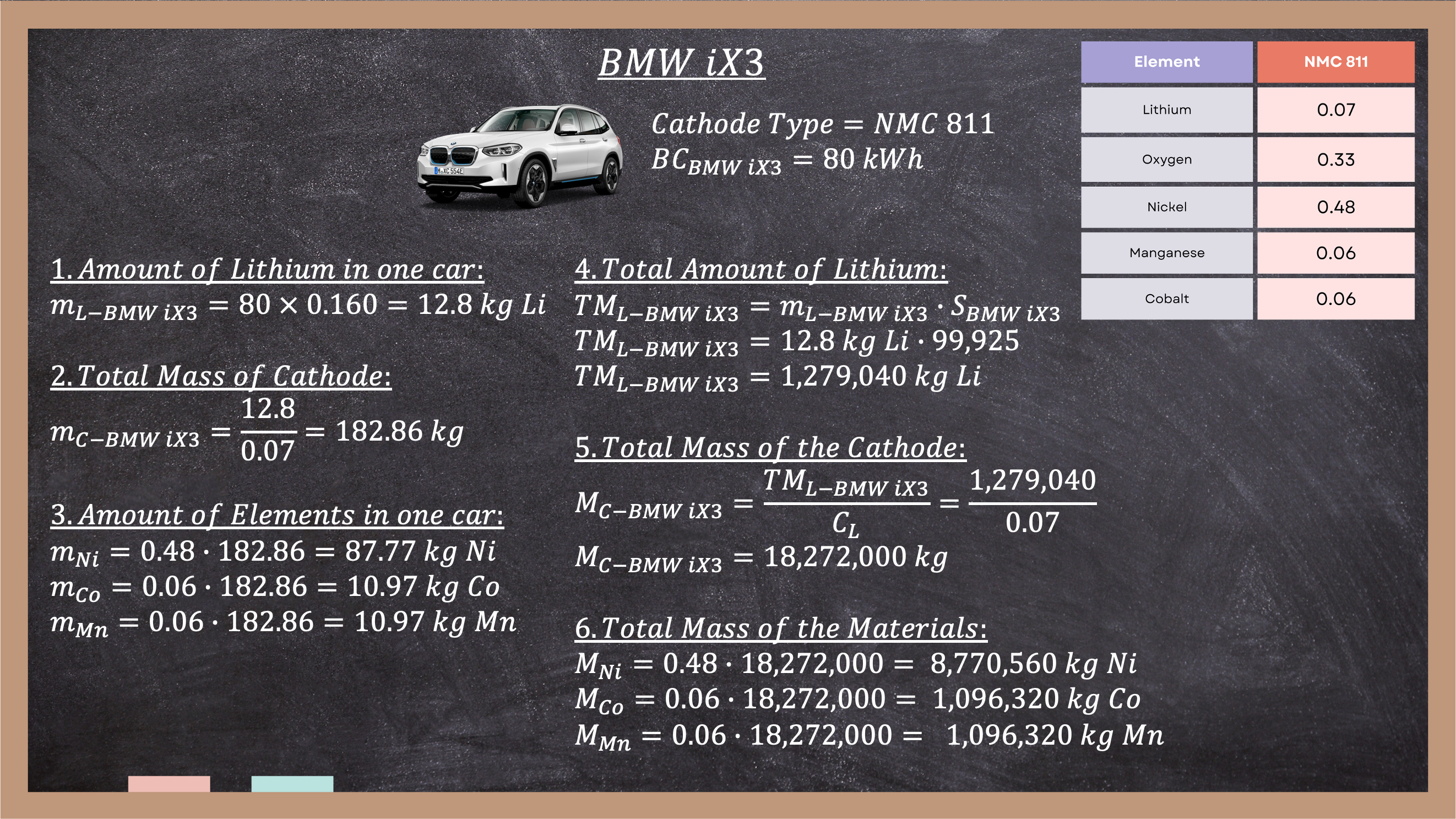
The calculations will use the BMW iX3’s battery as an example (please see board 2).
To summarize,
text
 Chemical Sustainability